


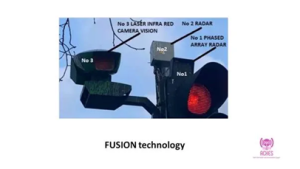
Radiation Emitted from Traffic Lights Harms the Public
Dr Lisa Hutchinson
Local authorities or councils are responsible for the planning adjudication aspects of telecommunications infrastructures. On numerous occasions, ACHES has explained to councils that certain telecommunications technology is dangerous and can pose significant risk to life. Despite this notification, many local authorities have ignored these warnings. Their lack of accountability, and complacent behaviour is shocking.
LIDAR: A Weapons System
In his latest video, military weapons expert Mark Steele literally walks us through all the evidence in plain sight, explaining the severe dangers of newly installed traffic monitoring equipment. Some traffic lights, for example, contain infrared laser systems, which are known as lidar. The Secore II unit mounted on traffic lights contains both lidar and optical vision technology. Only the vision aspect of the Secore II unit enables ANPR (automatic number plate recognition). On all pedestrian crossings in the ULEZ zones, mounted above the traffic lights are three units. A Secore II lidar and vision unit, and two phased-array radar units, which have been deployed without the knowledge of the public. Why is this so important that the public are informed? The below explanation will make this clear.
The lidar unit contains 24 laser diodes with a combined power output that is 21,600 times the accepted safe limit set by the government under the ICNIPR guidance—which is shocking in itself. The two phased-array radar units, similar to the lidar units, point at people as they queue at traffic lights. It is a known fact that radar is carcinogenic. In 2001, an academic paper by Dr Neil Cherry who conducted a study of police using radar, confirmed that “radiofrequency/microwave radiation is genotoxic”. Studies have shown that occupational exposure to this type of radar—that is, pulsed microwaves—causes brain cancer. This dangerous exposure has been noted even when police using radar devices stood behind, not in front, of the emitting radar device.
In London within the ULEZ zone, the traffic monitoring equipment is manufactured by YUNEX. There are phased-array antenna arrangements within the YUNEX equipment. One of the units is radiation hardened, and similar equipment to the traffic monitoring equipment in London has been installed in Newcastle and other cities in the UK. Examination of a dismantled YUNEX unit mounted on a traffic light shows it contains phased-array antennas. Essentially, one of these units is a radar gun, which is radiation hardened. The authorities have said that all this equipment is safe because it is CE approved. CE approval, however, is not a symbol of safety, as can be shown by the fact weapons that are also CE approved. CE-approved weapons that use phased-array radar, is exemplified in a United States patent, patent number US 7,051,636 B1.
LED Lights, Radar and Radiation
Another interesting aspect is the modulated frequency from the antenna in the lighting heads from the LED street lights themselves. The ubiquitous Telensa contains a 5G plate lens antenna, which scans the environment, including pedestrians, vehicles, and houses. The equipment mounted on the traffic lights includes a Chinese ANPR recorder, biometric facial sensors, and cavity-backed phased-array electronic weapons-style equipment. The HIC Vision camera was banned or revoked in the USA as a national security threat. In his video, Mark shows a telecommunications mast with two 5G antennas and a wireless area network (WLAN) transmitter. This enables massive irradiation of the population within close proximity. Inside the YUNEX lidar unit, there are two laser warning symbols. These warnings must be attached to pieces of hardware that emit non-ionizing radiation. These symbols should be displayed to the public, not hidden inside the apparatus!
Stereoscopic Laser Weapons
Another concerning part of the hardware is stereoscopic laser equipment. Modulated frequency is emitted from the 24-phased arrays inside the Secore II YUNEX unit. These units mounted on traffic lights have been erected with no public consultation. This equipment includes combined radar and lidar in order to do mesoscopic surveillance. Mesoscopic means at the nano (or atomic) level, and is effectively scanning individuals’ biometrics. All the data that is collected is backhauled through the made-in-China 5G modem to an AI computer, presumably located in China. Perhaps this is why the former head of MI6, Sir Richard Dearlove, has warned that China has far too much control over London’s traffic.
Heart Attacks
These traffic monitoring systems are a very advanced form of wireless technology. Wireless sensor networks can also cause heart attacks: a peer-reviewed paper published in 2022 in the International Journal of Internal Medicine, showed that oscillated wireless sensor networks can initiate cardiac arrest. All this equipment is capable of facial recognition and biometric scanning of every person approaching a traffic light whether by foot or in a vehicle. The emissions from the equipment mounted on traffic lights are significantly more dangerous than from mobile devices. The radar devices within the traffic equipment uses highly focused frequency beams of high intensity. These collimated beams are of high intensity and are directed and the immense power intensity does not drop-off over short or long distances. Thus, these beams exceed any safe threshold for human health, and are known to cause a multitude of chronic and acute illnesses.
ACHES Action
ACHES is aware that the harmful FUSION Technology involving electromagnetic radiation (EMFs) has been installed in traffic equipment by Transport for London (TfL). This technology is being used by TfL and the ULEZ equipment supplier, YUNEX. As mentioned, FUSION technology is a combination of radar (which is a known carcinogen) and lidar (in this case, near infrared laser light) in conjunction with visible spectrum light equipment. Drivers and pedestrians alike, when waiting at traffic lights, will be subjected to both laser light from laser diodes and also to harmful radar radiation. Light from near-infrared lasers can also cause cataracts (as noted in an ICNIRP paper); radar can cause cancer, which is well known by governments across the world. Furthermore, the equipment deployed by TfL is part of the 5G network, which involves collimation of signal, telemetry, and backhauling of the data. ACHES opposes the installation of harmful radar and lidar emitted equipment that has been erected on all traffic lights within ULEZ zones. The ULEZ zones in London have not only affected millions who travel for work in terms of cost compliance with the ULEZ, but these zones also represent covert surveillance as well as severe harm to public health. There is overwhelming evidence to support the legal dismantling of ULEZ hardware equipment on the basis of safety concerns.